If your flat or low-slope commercial roof is leaking or just aging out, you are usually choosing between a new TPO membrane or an EPDM rubber system. This guide walks through costs, lifespan, energy performance, and building conditions so you can match the roof type to your actual situation in PA, NJ, or MD.
What problem are you really solving on this leaking or aging flat roof?
Before you try to pick between a TPO membrane roof and an EPDM rubber roof, it helps to get clear on what you are actually trying to fix. If your flat or low-slope roof is leaking, the root cause is often a mix of aging seams, ponding water, and saturated insulation instead of just a failure of the surface material. Both TPO and EPDM are single-ply membranes, which means the sheet itself is only one part of an overall system that includes insulation, cover board, attachment, and drainage details.
Industry data shows that cost and lifespan for any commercial roof system are heavily influenced by things like membrane thickness, how it is fastened, the amount of sun and weather it sees, and how well water is moved off the roof. One national commercial overview notes that single-ply roofs like TPO and EPDM commonly live in the 18 to 35 year range when they are properly specified, installed, and maintained, but the low end of that range usually points to design or maintenance issues. If your current roof is leaking long before its expected service life, that is a red flag that the replacement needs more than just a new sheet welded or glued down.
In Pennsylvania, New Jersey, and Maryland, winters, freeze-thaw cycles, and heavy summer storms all put stress on seams, terminations, and drains. That is true whether the surface is white TPO or black EPDM. So the first step is usually a roof inspection that checks the deck, insulation, and drainage layout. Only then does the membrane choice start to matter. The good news is that both TPO and EPDM are well established and code-acceptable in the Mid-Atlantic, so you are choosing between two proven systems rather than gambling on an experiment.
- Confirm whether leaks are at seams, penetrations, or low spots with standing water.
- Have the existing insulation probed to see if it is wet or still usable.
- Check whether the roof has enough slope and working drains to move water.
- Look at how much useful life is realistically left in the current system.
- Decide if you plan to stay in the building long enough to benefit from upgrades.
How do TPO and EPDM roof systems really compare on cost and lifespan?
From a pure dollars-per-square-foot view, EPDM generally starts a bit cheaper than TPO for a full replacement on a low-slope commercial roof, but there is a lot of overlap. A national commercial roofing overview reports that TPO typically comes in around 6 to 10 dollars per square foot installed, with an 18 to 25 year life expectancy when the system is designed and maintained correctly. The same source places EPDM at about 5 to 9 dollars per square foot, with a longer 25 to 35 year expected life in many cases under similar care. That frames EPDM as slightly lower cost with a potentially longer service window on paper.
Regional data for Maryland aligns with those national ranges, but tightens them a bit. Some trade guides list TPO in the 5 to 8 dollars per square foot range installed and EPDM in the 4 to 7 dollars range for typical commercial flat roofs, assuming similar thickness and details. Another buyer guide focused on Mid-Atlantic flat roofs cites around 7 to 11 dollars per square foot for a 60-mil TPO system and 5 to 9 dollars for a 0.060 EPDM system, both with a roughly 20 to 28 year life expectation when well maintained. These numbers reflect the reality that once you add tear-off, insulation, tapered crickets, and safety setups, the membrane cost advantage narrows.
The gap in published lifespan ranges mostly comes down to track record. EPDM rubber has been around for decades and has many roofs that made it past the 30-year mark. TPO is newer but has evolved quickly, and current formulations are commonly quoted at 20-plus years of service in the field. In our climate, hail, rooftop foot traffic, and UV exposure matter as much as the brochure number. A thicker membrane, protected insulation, and reinforced walkway pads will usually buy you more real-world years than shaving a few cents per square foot off the bid, regardless of whether you choose EPDM or TPO.
- Expect TPO to run roughly 5 to 11 dollars per square foot installed in this region.
- Expect EPDM to run roughly 4 to 9 dollars per square foot installed in similar conditions.
- Recognize that thicker membranes and better details push both systems toward the higher end of those ranges.
- Plan on 20-plus years of service for either system when it is properly designed, installed, and maintained.
- Budget extra for tear-off, insulation upgrades, and drainage corrections beyond the membrane cost.
When is a bright white TPO roof the better fit for your building?
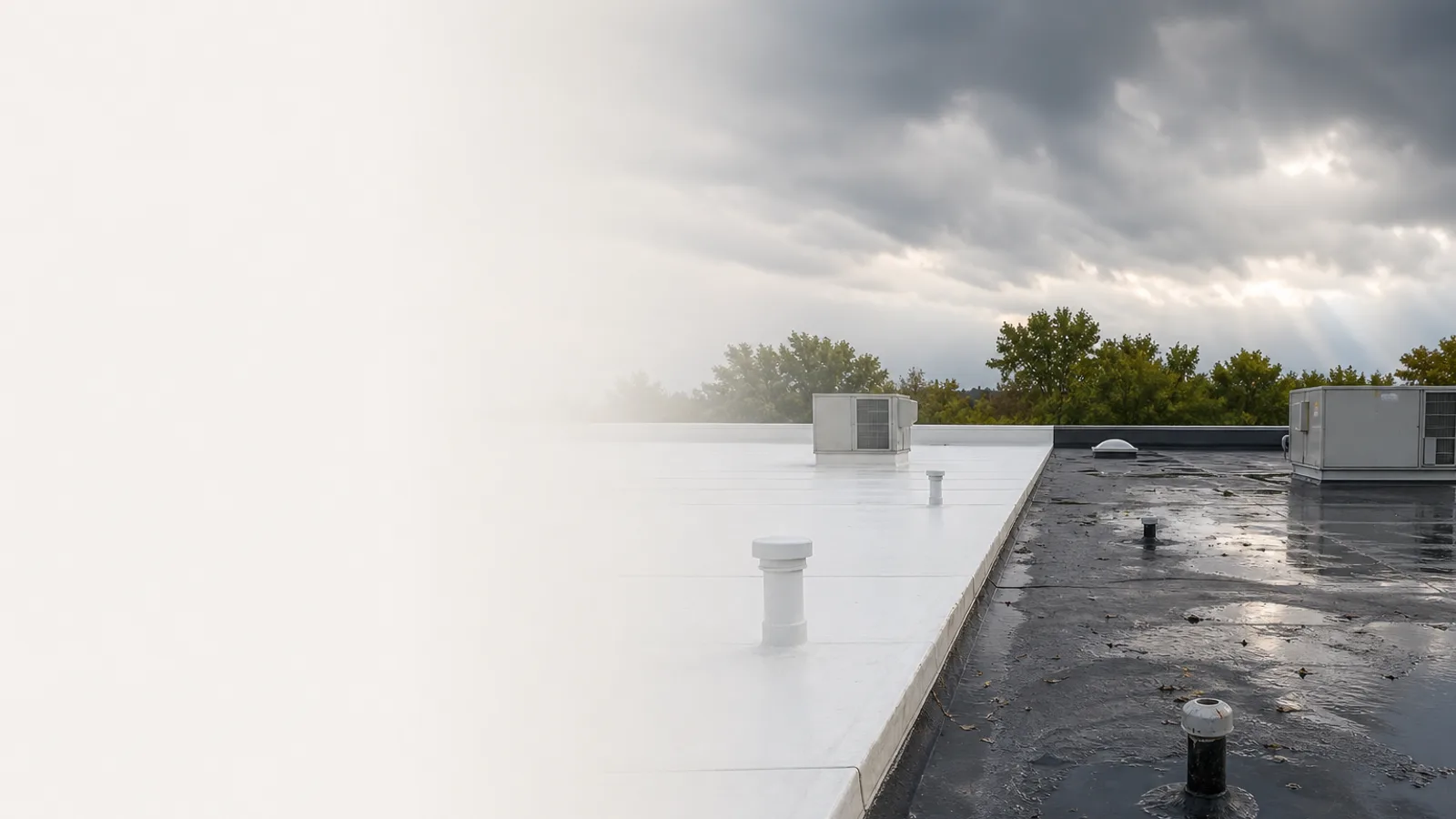
TPO is a thermoplastic membrane that is usually installed in a light color, commonly bright white. In hot weather markets and mixed climates like Pennsylvania, New Jersey, and Maryland, that reflectivity can cut roof surface temperatures compared to a dark surface. Trade sources in Maryland describe TPO as often the best overall value for commercial flat roofs because it balances moderate upfront cost with potential energy savings and relatively low maintenance on many buildings. If your building spends a lot on air conditioning or you have tenants complaining about top-floor heat, that white surface is worth a hard look.
Current energy codes in Pennsylvania call for a minimum R-30 of continuous insulation above the deck for most low-slope commercial roofs. When you are adding that much insulation, pairing it with a reflective TPO membrane can improve the total energy picture, especially on a large roof area. The higher R-value slows heat flow through the roof, while the TPO surface reflects more solar radiation away in the first place. Over the 20 to 30 year life window typically associated with TPO in Mid-Atlantic buyer guides, those cooling savings can help offset the slightly higher initial price compared to a basic EPDM system.
TPO seams are usually heat-welded, which creates a fused connection between sheets rather than relying on adhesive-lapped seams. That can be an advantage on roofs with a lot of foot traffic or complex detailing, since well-executed welds do not soften in heat the way some adhesives can. Code manuals, such as municipal stormwater standards in cities like Philadelphia, allow TPO as a fully waterproof membrane type as long as it meets the right ASTM standard and is detailed correctly at corners, edges, and penetrations. This means you can use TPO on most regulated commercial projects in the region without running into material approval issues.
When does a black EPDM rubber roof make more sense than TPO?
EPDM is a synthetic rubber membrane that comes mostly in black, with some lighter options. It has a long history on Mid-Atlantic commercial buildings and is known for staying flexible in cold weather, which is useful in Pennsylvania, New Jersey, and Maryland where freeze-thaw cycles are common. Several regional comparison guides note that EPDM usually comes in a bit cheaper than TPO, in the 4 to 7 or 5 to 9 dollars per square foot range installed for typical thicknesses. With lifespan ranges often given as 25 to 35 years, or at least 20 to 28 years in other buyer guides, EPDM can be a good fit if your priority is long-term durability at a modest initial cost.
EPDM’s dark surface absorbs more solar heat than TPO. That can be a drawback on heavily cooled buildings, but it can be neutral or even helpful on lightly cooled structures or where winter heating dominates. Warehouses, churches, light industrial spaces, or buildings with minimal summer cooling loads sometimes benefit less from a bright white roof and more from a proven, rugged membrane. If your building has rooftop equipment that requires regular access, EPDM’s rubbery surface can feel forgiving underfoot, which some owners prefer compared to a stiffer thermoplastic.
From a code and approval standpoint, EPDM is widely accepted for commercial waterproofing as long as the sheet meets recognized ASTM standards and is installed with proper seam and flashing details. City-level stormwater and development manuals list EPDM as an acceptable membrane type on low-slope roofs used as part of water management plans, again provided it meets the proper material standards. That tells you EPDM is considered reliable enough by regulators for critical waterproofing applications, not just as a budget choice. If your existing roof is already EPDM and the deck and insulation are in decent shape, a properly designed EPDM replacement or recover can also make detailing simpler because the new system aligns with what is already there.
- You want the lowest starting price within mainstream commercial roof systems.
- Your building has a modest cooling load or more winter heating than summer cooling.
- You value a long track record of EPDM roofs lasting 25 to 30-plus years in similar climates.
- You are replacing an existing EPDM roof and can reuse some design details.
- You prefer a membrane that stays very flexible in cold temperatures.
Key questions to answer before you pick TPO or EPDM for your flat roof
By the time you are looking at full replacement on a leaking or aging flat roof, the membrane type is only one decision in a longer list. Both TPO and EPDM can work well in the Mid-Atlantic as long as the rest of the system is designed right for the building. Many of the cost ranges you see for single-ply roofs assume a straightforward layout without extensive deck repair, but older roofs in Pennsylvania, New Jersey, and Maryland often need more work. Issues like rotten decking, undersized drains, or missing insulation can add significantly to the project, yet they are exactly the upgrades that prevent repeat leaks.
From an energy standpoint, state fact sheets and code references highlight that continuous insulation levels are moving up, not down. In Pennsylvania, the shift to R-30 continuous above the deck is one example. If you are going to open up the roof to that level anyway, it can be the right time to coordinate insulation, membrane choice, and attachment so the whole package is optimized. A white TPO system over code-compliant insulation may be worth more in total than its separate parts, particularly if your building is occupied during hot summer days. On the other hand, if energy use is relatively low or you are close to the end of your ownership horizon, a simpler EPDM system that hits code but does not chase every efficiency upgrade may be the more practical call.
The contractor’s experience with the system you pick also matters. A perfect membrane choice on paper cannot make up for rushed flashing details or poor seam preparation. Codes in cities like Philadelphia explicitly stress proper detailing at seams, corners, and penetrations for all single-ply systems, which is where many leaks start. When you review bids, ask not only whether the price is for TPO or EPDM, but also what thickness, what insulation R-value, how seams are done, and how they are handling ponding areas. That kind of detail will tell you more about future performance than the material name alone. When you are ready to compare design options for your own building, a seasoned crew can walk you through a full commercial roofing replacement or retrofit scope so you can see the tradeoffs clearly.
- undefined
- undefined
- undefined
- undefined
- undefined
- undefined
- undefined
- undefined
- undefined
- undefined
Frequently asked questions
- Is TPO or EPDM cheaper for a flat commercial roof in the Mid-Atlantic?
- Based on industry and regional buyer guides, EPDM usually starts a bit cheaper than TPO, with many Maryland ranges placing EPDM around 4 to 7 dollars per square foot installed and TPO around 5 to 8 dollars for similar thicknesses. A national overview lists TPO at about 6 to 10 dollars per square foot and EPDM at 5 to 9 dollars. Once you factor in tear-off, insulation, and drainage work, the total project costs often overlap, so it is important to compare full scopes, not just the membrane line.
- Which lasts longer on a flat roof, TPO or EPDM?
- National commercial roofing data typically quotes TPO lifespans in the 18 to 25 year range under proper design and maintenance, while EPDM is often listed at 25 to 35 years in similar conditions. Some Mid-Atlantic buyer guides group both in the 20 to 28 year range when maintenance is consistent. In practice, membrane thickness, exposure, and detailing have a big influence, so a thicker, well-installed TPO can outlast a thin, poorly detailed EPDM and vice versa.
- Is a white TPO roof really better for energy savings than black EPDM?
- A white TPO membrane reflects more sunlight than a black EPDM roof, which can lower roof surface temperatures and help reduce cooling loads, especially on buildings with significant summer air conditioning use. Energy code materials for Pennsylvania note that higher insulation levels are already required, so combining that insulation with a reflective surface can improve overall energy performance. If your building has low cooling demand or is used mainly in colder seasons, the energy advantage of TPO may be less pronounced.
- Can both TPO and EPDM meet commercial roofing code requirements in Pennsylvania, New Jersey, and Maryland?
- Yes, both TPO and EPDM are widely accepted in Mid-Atlantic building and stormwater regulations as long as they meet the appropriate material standards and are detailed correctly. For example, a stormwater management manual in a major Pennsylvania city explicitly lists EPDM and TPO as permitted waterproofing membranes when they comply with ASTM specifications and have proper seams and flashing. State-level codes focus more on insulation levels and overall roof performance than on choosing one of these two membranes over the other.
- Is it worth replacing my old EPDM roof with TPO just for energy savings?
- Switching from a dark EPDM roof to a white TPO system can improve reflectivity and may reduce cooling costs, but the payback depends on your building’s size, HVAC usage, and the cost difference between the systems. Trade sources point out that TPO’s slightly higher upfront price can be offset by lower maintenance or energy use over 20 to 30 years on some buildings. To know if it is worth it in your case, you need a basic life-cycle comparison that estimates energy use and looks at how long you plan to hold the property.
- What should I ask a contractor before choosing TPO or EPDM for my leaking flat roof?
- Ask the contractor to explain what is causing the current leaks, what insulation level they are proposing, and whether they recommend TPO or EPDM for your specific drainage and exposure conditions. Request bids that spell out membrane thickness, attachment method, details around penetrations, and any required deck repair. It also helps to ask how each option affects code compliance and projected lifespan so you are not just picking based on a material name or the lowest starting price.
Talk to All Pro Home Improvement and Roofing about commercial roofing →