
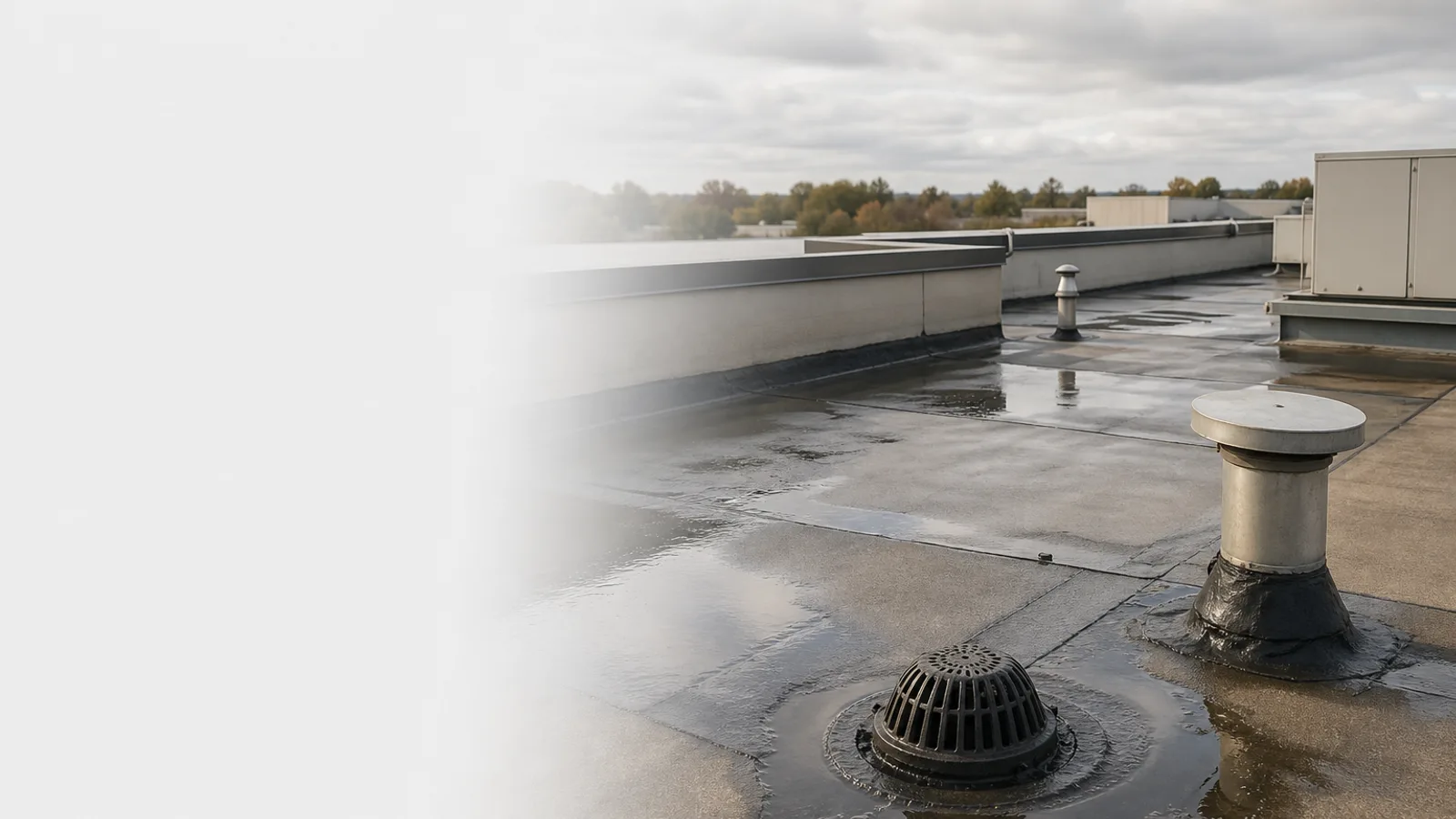
If water is showing up inside your commercial space, the leak usually started at a specific weak spot on the flat roof, not in a random puddle. This guide walks you through the common causes, what that leak can turn into if you wait, and how a commercial roofer actually solves it.
What is a flat roof leak really telling you about your building?
When you see a brown ceiling stain or a bucket catching drips in your commercial space, the leak did not start at that spot in the drywall. On a flat or low-slope roof, water usually enters at a weak detail like a seam or a penetration, then travels sideways through insulation before it finally finds a path down inside. That is why the first job is not to patch where you see water, but to understand how your roof is built and where it tends to fail.
Most commercial flat roofs in Pennsylvania, New Jersey, and Maryland are some form of single-ply membrane like TPO, EPDM, or PVC, or an older built-up or modified bitumen system. Each one has its own weak points and compatible repair methods. A commercial roofer will start by mapping the leak inside, then working upslope on the roof surface to drains, penetrations, and seams, because the research shows these are the places where leaks start most often. Knowing that pattern helps you avoid wasting money on guesswork repairs that do not touch the root cause.
- Interior stains rarely line up directly under the roof entry point
- Water often travels horizontally inside saturated insulation
- Flat roofs fail at details more often than in the open field
- Different membranes require different repair materials
Where do commercial flat roofs actually leak first?
Across multiple guides on commercial maintenance, the same trouble spots keep coming up. Seams where single-ply sheets overlap, flashings around walls and equipment curbs, drains, and edges are responsible for most leaks, not the center of the roof. As roofs expand and contract with temperature swings, these detailed areas move the most, which can open up tiny gaps that slowly let water in.
Anywhere something pokes through your roof is a risk. Pipes, HVAC stands, vents, and skylights need tight flashings that stay flexible as they age. If they dry out, crack, or were not installed correctly, water can slip under the membrane and into your insulation. Drains are another big one: a blocked or undersized drain leaves ponding water, which loads the roof with standing water and speeds up membrane wear around that area. Understanding this pattern means you can ask a roofer exactly what they checked when they say the leak is “fixed.”
- Seams between membrane sheets that have split or lost adhesion
- Flashings at walls, parapets, and rooftop units that have cracked
- Plumbing vents, conduits, and other penetrations with loose seals
- Roof drains and scuppers clogged with leaves or debris
What causes a flat roof to start leaking in the first place?
Flat roofs do not usually fail overnight. Most leaks are the end result of slow changes that finally hit a tipping point. Thermal cycling is one: every hot day and cold night makes the roof expand and shrink. Over years, that movement can pull at seams and flashings until a tiny opening appears. On single-ply systems, heat-welded seams can weaken or peel, and on EPDM, laps can lose their bond if the adhesive ages out.
Drainage is another underlying cause that shows up again and again in technical guides. If the roof was built with inadequate slope, or drains become clogged, water ends up sitting in shallow ponds after every storm. Long-term ponding can shorten the life of many membranes and can expose any small defect in seams or flashing because the area stays wet instead of drying after rain. Foot traffic, dropped tools, and added equipment can puncture or stress the membrane as well, especially along walk paths and around mechanical units. Over time, moisture can work through to the insulation and even the deck, turning a simple patch job into a bigger repair decision.
What can a leaking flat roof lead to inside your building?
A slow leak in the roof does more than drip on the floor. Once water gets under the membrane, it can saturate the insulation. Several of the expert guides warn that wet insulation loses its thermal performance and can start to deteriorate, which means you may be paying to heat and cool the outdoors without knowing it. If moisture reaches the deck, you can see metal corrosion or decay in wood or fiberboard, and that creates a structural and safety issue, not just a comfort problem.
Inside the building, you already know what water can do. Stained ceiling tiles, damaged drywall, and potential mold growth mean disrupted tenants, employees moved around, and sometimes inventory or equipment at risk. Property managers and owners also have to keep an eye on code issues. Some regions require that when a flat roof repair affects a large area, it counts as an alteration that must meet newer energy or cool-roof requirements. That decision point typically comes up when leaks are widespread or when there is extensive wet insulation. At that stage, it may be more practical to move from spot repairs to a planned replacement that addresses drainage and insulation in one project.
How does a commercial roofer actually find and fix a flat-roof leak?
A good commercial roofer does not walk up, slap on some generic coating, and call it done. The process starts inside by documenting where you see leaks, then translating that to the roof plan. From there, they move upslope, checking seams, flashings, penetrations, and drains in the suspected area, because water rarely enters at the lowest visible stain. Detailed inspection often includes cutting a few small test openings to see whether the insulation is dry or wet and how far moisture has spread.
Once they know the source and the roof type, the repair technique is matched to that system. For single-ply roofs, that may mean cleaning and re-welding a TPO seam, re-adhering an EPDM lap, or replacing a damaged flashing at a curb. For built-up or modified bitumen roofs, it can involve installing new plies or a new cap sheet over a torn or blistered area. The guides stress repeatedly that you need to use repair materials compatible with your existing membrane. Putting the wrong product on your roof can cause the patch to fail and can even void a manufacturer warranty, which is the last thing you want if the roof is still under coverage.
When is repair enough, and when should you plan for replacement?
The big question every owner asks is whether a leak can be handled with repair or if it is a sign the whole roof is at the end of its life. The answer is rarely one-size-fits-all. If the membrane is generally in good shape and the leak is tied to an obvious issue like a split seam, cracked flashing, or a specific puncture, targeted repairs are often the most cost-effective move. Dry insulation around the area is a good sign that the problem is still localized.
On the other hand, if your roofer finds large areas of saturated insulation, widespread seam failures, or long-term ponding that cannot be corrected with simple drain work, the balance starts to shift. Several technical resources point out that once repair areas get large, other requirements can kick in, such as needing to bring the roof up to current energy performance or cool-roof standards. In our Mid-Atlantic climate, that might also be the right time to improve slope or add tapered insulation to get rid of chronic ponds. This is where a detailed roof condition report, photos of trouble spots, and a discussion of local code triggers help you make a smart decision instead of chasing leaks one by one.
If you reach this point, you are usually looking at a broader scope of commercial roofing work that addresses not just the leak you see today but how the whole system drains and performs over the next decade.
- undefined
- undefined
- undefined
- undefined
- undefined
- undefined
- undefined
- undefined
- undefined
Frequently asked questions
- Why is my flat roof leaking if the membrane looks fine from above?
- Flat roofs often leak at details that are easy to miss at a glance, like a hairline seam opening, a cracked flashing, or a gap around a pipe. Water can then travel under the membrane through the insulation before it shows up inside, so a quick surface walk-through may not reveal the real problem without focused inspection.
- Where do commercial flat roofs usually leak first?
- Most expert guides agree that flat roofs leak first at seams, flashings, drains, and penetrations. These locations move and flex more than the open field of the roof, and they concentrate water when drainage is not perfect, which makes them the first places to break down over time.
- Can a small flat roof leak cause serious damage if I wait to fix it?
- Even a small leak can saturate insulation over time, which cuts its thermal performance and can lead to higher energy use. If moisture reaches the roof deck, you can end up with corrosion or rot, and interior finishes like ceiling tiles and drywall are at risk too, so delays usually increase both repair scope and cost.
- How do roofers find the source of a flat roof leak when water travels?
- Roofers typically start by mapping the interior leak, then move upslope on the roof to inspect likely sources like seams and penetrations. They may use test cuts or moisture detection tools to see how far water has spread through the insulation, because the entry point is often some distance away from where you see a drip.
- Should I keep repairing my leaking flat roof or plan for a replacement?
- If your roof membrane is generally sound and leaks are tied to specific details, targeted repairs can be a good value. When there are widespread seam failures, chronic ponding, or large areas of wet insulation, it is often smarter to plan for a replacement that improves drainage, insulation, and compliance with current requirements.
- Does using the wrong patch material on a flat roof really matter?
- Yes, using products that are not compatible with your roof membrane can cause the patch to fail prematurely and may void any manufacturer warranty on the system. That is why experienced commercial roofers first identify the roof type and then select repair methods and materials that are designed to work with that specific membrane.
Talk to All Pro Home Improvement and Roofing about commercial roofing →