Recent industry data shows commercial reroofing backlogs stretching up to 5 months as low-slope demand outpaces residential work. If you own or manage a building in PA, NJ or MD, booking inspections and projects before winter snow load hits can be the difference between a planned job and an emergency shutdown.
Why commercial roofing is already busy before winter even starts
Across the industry, commercial roofing is not slowing down. The latest Quarterly Market Index Survey for Reroofing reports that low-slope work, which is the bread and butter of commercial roofs, is seeing stronger demand than steep-slope residential-style projects. Inquiries and signed contracts for commercial reroofing are holding up because building owners are focusing on maintenance and replacement, not just new builds. That means contractors who specialize in flat and low-slope systems are already filling their calendars well before the first snowflake hits a parking lot.
The same survey shows a clear picture of backlog. Only about 30 percent of roofing respondents reported no backlog at all, while the rest are carrying anywhere from one to more than five months of scheduled work. Another industry outlook for 2026 points to commercial reroofing, repair and public-infrastructure work as the steady core of the market, even while some other segments stay soft. For you, as an owner or facility manager in Pennsylvania, New Jersey or Maryland, that means the window for easy scheduling is earlier than it used to be. By the time late winter leaks appear, you are competing with everyone else who waited.
This matters more in our region because Mid-Atlantic winters are unpredictable. Some years bring a few light snowfalls, and others load low-slope roofs with heavy, wet snow followed by rapid thaw. Even seasons without a big headline storm put stress on seams, flashings and rooftop equipment through constant freeze-thaw cycles. When you stack that on top of industry-wide backlogs, you can see why the demand spike after winter is getting sharper and why the smart move is to reserve time before you see water spots on ceiling tiles.
- Commercial reroofing inquiries are stronger than residential work.
- Most contractors report at least one month of work already booked.
- Industry outlooks say reroofing and maintenance are driving demand.
- Mid-Atlantic weather swings add risk without warning.
How winter snow load really damages commercial roofs
In our area, winter roof failures are not usually about dramatic collapses. Most commercial roofs in PA, NJ and MD are designed with a safety margin for snow weight, within the limits of building codes at the time they were built. The real trouble shows up in slower, less obvious ways. Heavy, wet snow sits on a low-slope roof, melts during a mild day, then refreezes at night. That constant shifting from ice to water and back again works its way into seams, flashings and tiny imperfections that were harmless in dry weather.
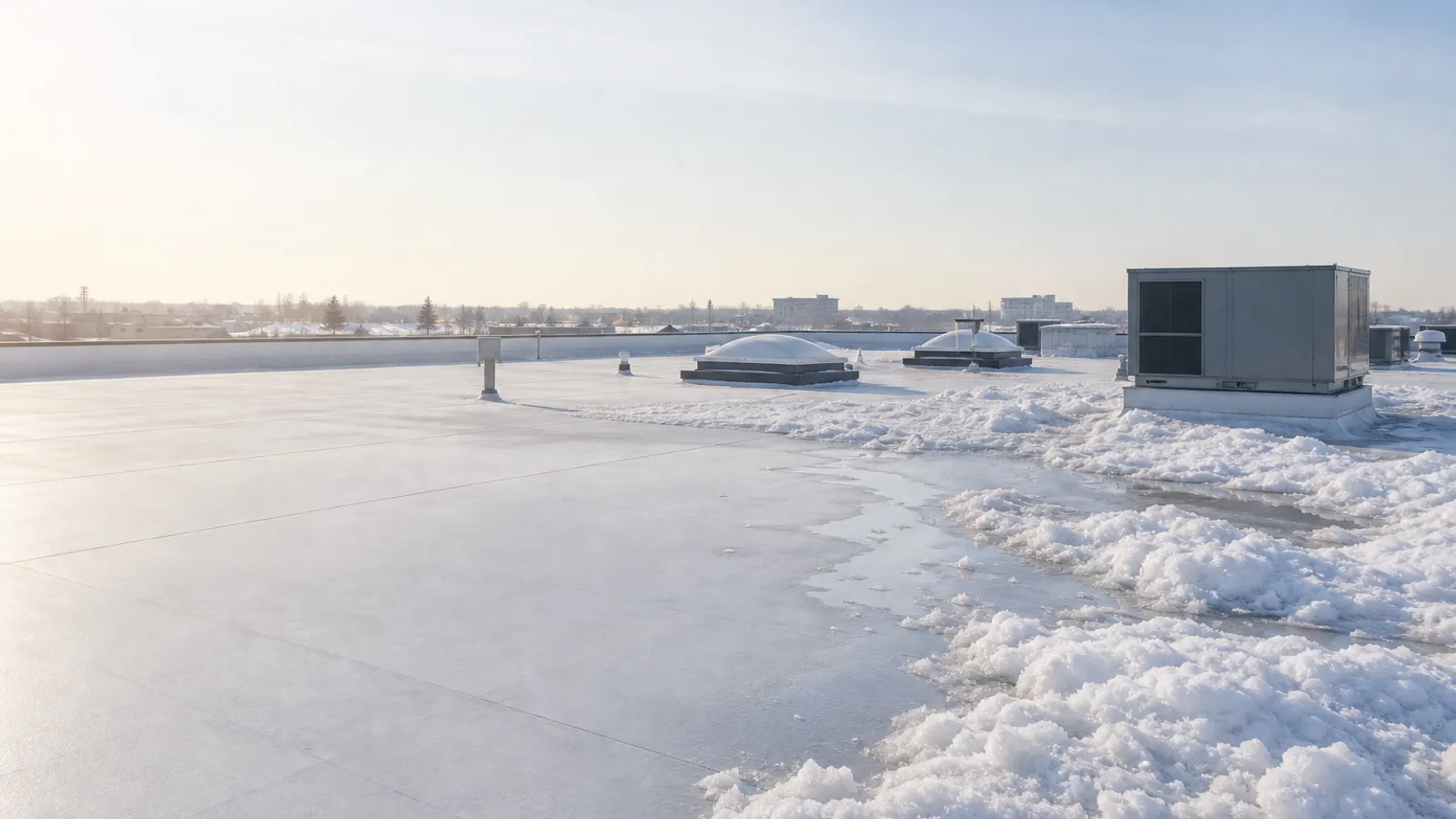
As small gaps open, water can travel horizontally through insulation and deck layers long before it drips into a space you can see. Pitched roofs shed snow quickly when the sun comes out, but low-slope surfaces with poor drainage keep ponding water in place around drains, scuppers and HVAC curbs. When that water refreezes, it expands and can crack or separate membranes and sealants. Over several winters, that cycle turns a roof that looked passable in the fall into one that starts leaking in late February or March, right when crews are already busy.
Roof age makes the problem worse. The industry analysis for 2026 notes that many owners are now dealing with aging assemblies that have already survived multiple years of storms and temperature swings. Older membranes lose flexibility, fasteners back out slightly and previous patch jobs become weak points. Snow load and freeze-thaw cycles simply expose what is already fragile. That is why many facility managers now schedule roof assessments early and plan reroof projects before winter rather than waiting for ice to force the issue.
What the latest data says about post-winter wait times and backlogs
The same reroofing index that highlights strong commercial demand also breaks down how far out contractors are booked. Roughly one third of respondents say they have one to two months of backlog, almost one quarter carry three to four months, and more than one in ten report five months of committed work or more. Only about 30 percent say they can start a project right away. Those numbers are not specific to a single state, but they set expectations for how crowded schedules have become across the U.S. and Canada.
The 2026 industry Q and A reinforces that this is not a short-term blip. Commercial roofing demand is expected to “hold up” thanks to ongoing maintenance and reroofing, especially in sectors like schools and hospitals that cannot ignore leaks. At the same time, contractors are still dealing with labor tightness and cautious buying on materials. That combination means that when a rush of calls comes in after a harsh winter or heavy snow event, schedules do not stretch easily. Jobs stack up in order of safety risk and severity.
You can see how this plays out on the ground. Owners that call in the spring with active leaks or saturated insulation often hear that the earliest full reroof slot is weeks or months away, even if small temporary repairs can be done quickly. For occupied buildings, that can mean rearranging tenants, shifting production or cordoning off wet areas until the permanent work is complete. For anyone responsible for budgets, it also shrinks your ability to stage work across fiscal years. Planning in advance and locking in a window for your commercial roofing project helps you sidestep that pileup.
- About one third of contractors carry 1-2 months of backlog.
- Nearly a quarter report 3-4 months already booked.
- More than one in ten have 5 or more months of work scheduled.
- Only about 30 percent report no backlog at all.
How commercial owners in PA, NJ and MD can get ahead of the snow-load rush
In Pennsylvania, New Jersey and Maryland, winter roofing demand hits in waves. The first wave comes from owners who had inspections done in the fall and already know they want a reroof or major repair. The second wave starts when the first real storm exposes weak points in aging roofs and facility teams begin to notice spots on ceilings or damp insulation. By late winter and early spring, calls are coming in from buildings with recurring leaks around drains, roof edges and rooftop units.
If you are responsible for a low-slope or flat roof here, you have more control than it might feel like. The industry data shows that reroofing is not just a reaction to disasters; it is planned work driven by asset management. That plays in your favor if you lean into planning instead of waiting. Step one is to know the age and basic condition of each roof section you manage. If your main roof is approaching or past its expected service life, especially with visible ponding or patchwork repairs, treat it as a candidate for scheduled replacement instead of hoping for another winter without leaks.
Next, use fall and early winter for documentation and scoping. A good inspection should include photos of seams, flashings, drains, terminations and any mechanical penetrations, plus a clear written summary of issues. From there, you can prioritize which areas need immediate attention, which can be repaired and monitored, and which are better addressed as a full reroof. When you have that picture before heavy snow, you can talk scheduling instead of begging for an emergency slot when the backlog is at its peak.
How to book your commercial roofing work before winter snow load hits
Booking early is not just about getting on a calendar. It is about giving yourself time to make decisions without rushing. In the current market, where commercial reroofing is carrying the load of demand, the best time to start the conversation is late summer through mid fall. That gives you room for inspection, scope development, budget approval and permit planning before the worst weather arrives. Even if you decide to perform the actual reroof in spring or early summer, you can often reserve a time window before everyone else calls in after a rough winter.
When you reach out to a contractor, be as specific as you can about your building type, roof access, known leaks and past roof work. Ask what their current backlog looks like for projects your size and complexity. The recent survey data suggests many firms are already scheduling one to several months out, so a straight answer on timing matters. Also ask how they handle emergency calls during peak seasons, and whether they offer condition reports that you can use for internal capital planning. The more clarity you have now, the fewer surprises you will get after heavy snow or ice.
Finally, protect flexibility in your own schedule. If operations can only tolerate certain shut-down windows, share that early. In some cases, it makes more sense to plan a controlled reroof a few weeks after winter than to live with tarps and buckets under ceiling tiles while you wait for an open slot. The key is remembering that in our region, snow and freeze-thaw cycles are a “when,” not an “if.” Getting your booking done ahead of that reality lets you treat roofing as a managed project instead of a crisis.
- undefined
- undefined
- undefined
- undefined
- undefined
- undefined
- undefined
- undefined
- undefined
- undefined
Frequently asked questions
- Why does commercial roofing demand spike after winter snow loads?
- Many commercial roofs do not show problems until after snow has melted and refrozen several times, which opens up seams and weak points. When leaks finally appear in late winter or early spring, a lot of owners call at once, and contractors who already have months of backlog add those emergency jobs on top. Industry surveys show that commercial reroofing activity is already strong, so the post-winter rush simply stacks on existing demand.
- How far in advance should I book a commercial roofing project before winter?
- Based on recent industry data, a large share of contractors are already booked one to four months out, with some at five months or more. To avoid getting stuck behind that line, you should start conversations in late summer or early fall and try to reserve a slot at least one to three months before you want work to start. That gives time for inspections, scoping and permits before severe weather hits.
- What kind of snow load problems should I expect on a flat commercial roof?
- In the Mid-Atlantic, heavy, wet snow and repeated freeze-thaw cycles are the main issues for low-slope roofs. Snowmelt can pond around drains and rooftop units, then refreeze and stress membranes, flashings and sealants. Over several winters, that process can lead to hidden moisture in insulation and slow-developing leaks instead of dramatic structural failures.
- Why are commercial reroofing projects staying strong when other construction slows?
- Industry outlooks for 2026 point to maintenance, reroofing and infrastructure work as the backbone of commercial roofing demand. Even when new construction cools off, owners of existing buildings still need to keep water out of schools, hospitals and workplaces. Aging roof systems and repeated weather extremes are pushing more owners to invest in reroofing rather than waiting for severe damage.
- What questions should I ask a commercial roofer about winter scheduling?
- Ask how many months of backlog they currently have and whether that estimate includes projects similar in size to yours. You should also ask how they handle emergency leak calls during winter, whether they can provide written condition reports for planning, and what their typical lead time is between signed contract and start date. Clear answers help you know if they can realistically meet your timeframe.
- Is it better to reroof before or after winter in Pennsylvania, New Jersey or Maryland?
- There is no single right answer, but planning ahead is critical either way. Many owners choose to inspect and sign contracts in the fall, then either complete the project before severe weather or lock in an early spring slot. What you want to avoid is waiting until leaks show up after snow load, when backlogs are longest and you may have fewer options for timing and scope.
- How do labor shortages and material costs affect commercial roofing timelines?
- Industry commentary for 2026 notes that tight labor markets and higher material costs are still pressuring roofing schedules and budgets. With fewer experienced crews and longer lead times for some products, contractors cannot always absorb sudden surges in demand. As a result, projects are often booked further in advance, and owners who plan early have a better chance of getting their preferred timing and system options.
- What can I do now if my commercial roof is old but not leaking yet?
- If your roof is near or past its expected service life, treat this as a planning window, not a reason to relax. Schedule a detailed inspection, document any minor defects and ask for budget-level pricing on repair versus reroof scenarios. With that information, you can choose whether to book work ahead of the next winter or set up a phased plan before small issues turn into mid-season emergencies.
Talk to All Pro Home Improvement and Roofing about commercial roofing →